top of page

Knock, Knock, Descendants Calling!
  • Writer: Karen Derrick-Davis
    Karen Derrick-Davis
  • Mar 31
  • 4 min read

Updated: Apr 1

A library with wooden beams and yellow accents. People at a central desk, surrounded by bookshelves and colorful carpet patterns.
The gorgeous Montgomery County, MD library.

On a recent trip, we headed to Virginia and Maryland. I knew I had ancestral ties there, but was not very sure exactly where.


After some digging, I realized several branches were well-represented along the Maryland side of the Potomac, so I headed to the Montgomery County Library. With the expert help of the librarian, I was able to find several addresses of homes that had been in the family. She was so good!


Several of my ancestors' homes were listed in historical reference books, which was great to find. Daniel Trundle who built "Annington" in 1813 was my 4th great-granduncle.

A hand with a blue bracelet holds open a book. The page shows black-and-white photos of houses with accompanying text detailing their history.
Atlas cover titled "Atlas of Fifteen Miles Around Washington, Including the County of Montgomery, Maryland," dated 1879. Brown ornate text.
Hand holding a 1976 map book titled "Locational Atlas & Index of Historic Sites in Montgomery County, Maryland" on a desk with papers and a blue shirt.

I knew one of the homes I wanted to find was on the Little Monocacy River and at one time had a mill, so the librarian pulled some books that led me to the location of a home I was not expecting to find. My 3rd and 4th great-grandmothers had been born "on the Little Monocacy River."

A yellow book titled "The History of Dickerson, Mouth of Monocacy Oakland Mills" with an illustration of a train station on the cover, lies on a surface next to blue fabric.
A useful book that led me to the location of the house where my 3rd great-grandmother (and maybe her mother as well) was likely born.

The house was such a find! One book even listed the exact present-day address.


Open book page with text about Mount Carmel, detailing its history and architecture. Includes a black-and-white photo of the building. Page 160.
An entry about Mount Carmel, built by my 5th great-grandfather, Thomas Veitch, and bequeathed to his daughter, Mary Veitch, who married John Lewis Trundle.

Time for House Hunting

With these and other houses to find, I had some adventuring to do, so I asked my cousin's 24-year-old daughter to join me (and drive!). Of course, lunch was part of the bargain, as well!


We easily found Daniel Trundle's home, Annington, but it was currently closed for renovation. I didn't feel comfortable climbing the fence and walking up to the house, so we took a photo from afar.

Brick house partly hidden by trees under a clear blue sky, with a grassy foreground. Peaceful, rural setting.
Annington, built for my 4th great-granduncle Daniel Trundle.

We drove by another Trundle home with one of the only remaining examples of a "banked barn" in the county.

A banked barn built by my 4th great-granduncle, Otho Trundle, around 1816. He enslaved 12 people in 1810 and 16 in 1820, so I imagine this barn was built by them.
Frontal view of Otho Trundle's banked barn.
Enough Trundles around to have a Trundle Road.

Now, it was time to find the Veitch house! We drove along Dickerson Road and missed the house. It was set back up a curved driveway and behind a grove of trees. To my cousin's daughter's horror, I asked her to slow down and pull a little into the driveway. "What if they have cameras?!?!" She was truly unnerved to fulfill the request of this crazy much-older cousin.


We continued a little further, then turned around to make another pass. This time, she agreed to pull off into the bottom of the driveway right next to the road. I said, "I am going to walk up that driveway and knock on the door. Are you coming with me?"


The short and uncomfortable answer was, "No."


OK, I get it. She had not had the experiences I had had. This was the fourth ancestral home I had "cold-knocked." I was unafraid and knew I may never have another chance. I left her in the car and gingerly strolled up the driveway. When I came to the top, the door to the beautiful house was behind a little fence that I did not feel comfortable going into. So, I just strolled back and forth a little, gazing at the house and outbuildings.

Within a couple minutes, a woman with a baby on her hip opened the front door and asked, "Can I help you?" in a wary sort of way. I cheerfully and respectfully said, "I think my ancestor built this house." She answered, "Really? Come on in!!"


Yay! Another successful cold-knock!


I called on my phone to my fieldtrip partner in the car. She was startled and thought I was calling because I needed help -- was in trouble, or something! I said, "We've been invited in! You want to drive up and come?" Thankfully, she said, "Yes" to her nutty cousin.


The Veitch/Trundle/Gott House Upclose

The house was so fascinating! It is called a "telescopic" house because it was built in stages and looks as if it could be collapsed together like a telescope.

Stone house with a blue door and a metal roof set in a grassy yard. Overcast sky and trees in the background create a serene mood.
The Veitch/Trundle/Gott House

Our host, who was the daughter of the home's owner, said they love that the house's history is so tied to women -- having been passed down to daughters over several generations -- which explains why the family name affiliated with the house changed with each generation. Thomas and Laurana Veitch bequeathed the home to their daughter, Mary (husband, John Trundle), who bequeathed the home to her daughter, Mary (husband, Richard Gott).

Stone fireplace with a wooden mantel, decorative plates, and a framed spoon set. Rustic ambiance with a brick interior and a metal screen.
The cooking fireplace.
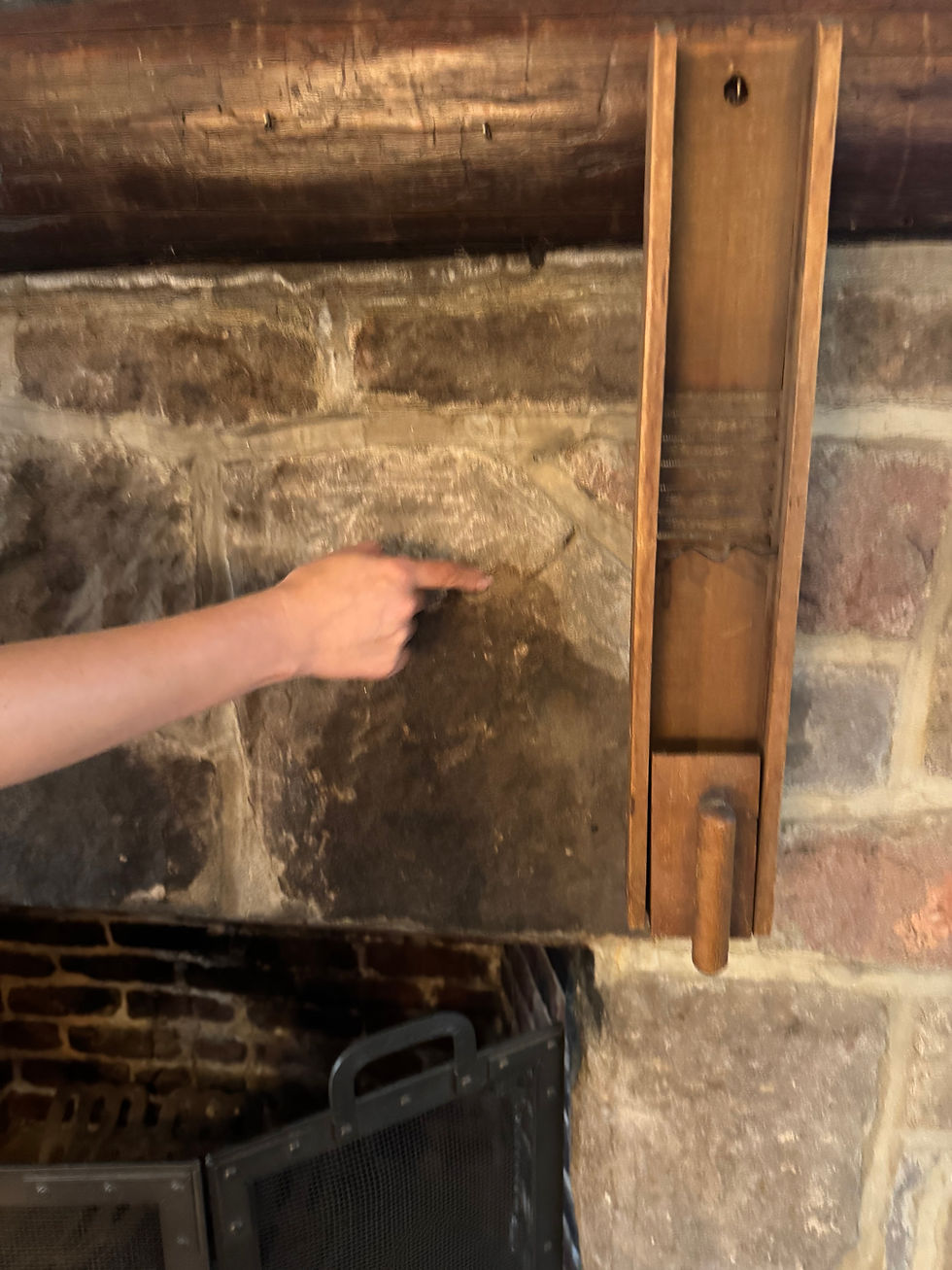
Finger pointing at a stone wall inside a rustic fireplace setting with wooden beams. A mesh fire screen is partially visible below.
Our host pointing out a bullet hole from the Civil War in the fireplace.
Person in jeans and beige sweater climbing narrow stairs, holding a phone. Dimly lit, with beige walls and a small ceiling light.
Going up the narrow staircase.
Dark well-worn wooden stairs in a narrow space, lit by a wall lamp. Beige walls and a closed light blue door on the left. Cozy, confined mood.
A well-worn 1800s staircase.
Wooden spiral staircase leading up to a hallway with a table. Dark wooden floors and white walls; a hand is visible on the railing.
Where two of the house sections come together. It's a pretty tricky maneuver to get from one to the other.
Cluttered storage room with stone walls, paint cans, cleaning supplies, a pet carrier, and a sign reading "This home ♡s the planet." Dim lighting.
This is the oldest part of the house, which was built initially as slave quarters and a dairy.
Close-up of a rustic stone wall with reddish-brown and gray stones. Visible mortar lines create a textured pattern. The numbers 183 with the last number missing due to eroded stone.
Black stone with 183_ etched in it. The final number of the year is missing, having eroded away with the crumbling rock.
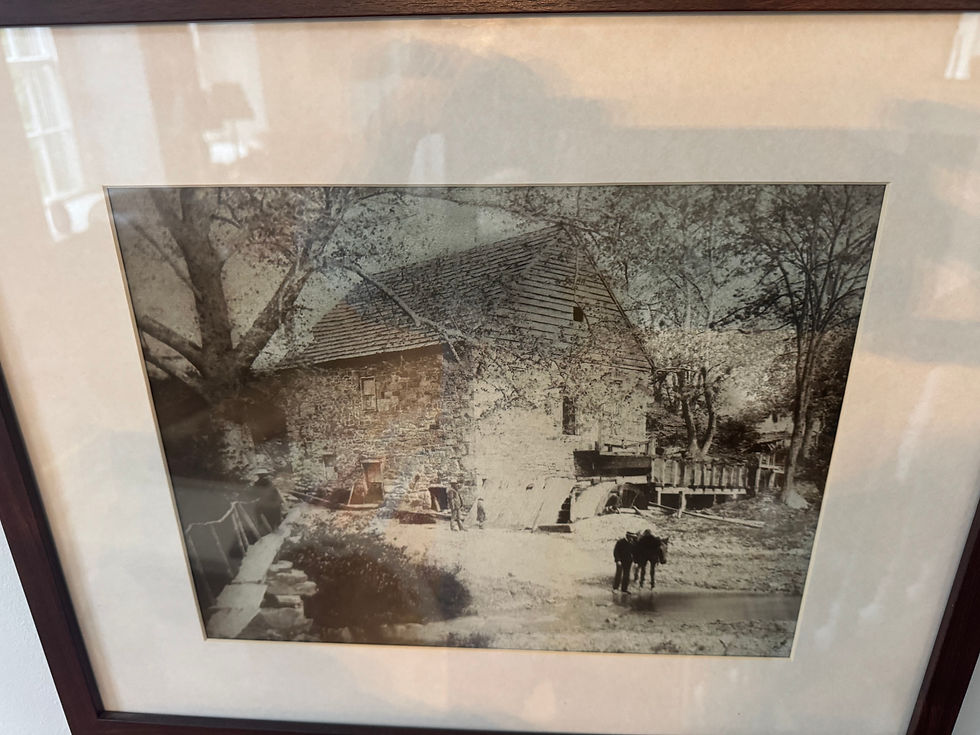
A photo of the old mill on the Little Monocacy River.
Overgrown wooden steps lead down a grassy slope to a creek, surrounded by lush green trees. Peaceful woodland setting with earthy tones.
The stairs leading down to the Little Monocacy River. The Gott's mill was on the river to the right.

Another Adventure in the Books!

Two people smiling at a café table with drinks and art on the wall. Other patrons chat in the cozy setting.
Lunch!

The Gift of Identity

The next step for me will be researching and documenting the folks my Maryland ancestors enslaved--as I am doing with multiple branches of my family tree. My mission is to learn as much as I can about these real people who have not been adequately documented and recognized as truly existing -- only mentioned in passing or as a footnote to my white enslaver ancestors and most often without names and identities.

2 Comments

Rated 0 out of 5 stars.
No ratings yet

Add a rating
Jane Derrick
Apr 08
Rated 5 out of 5 stars.

So happy to see you and your companion and the homes of our ancestors.

Like

Paul Derrick
Apr 06
Rated 5 out of 5 stars.

Wow, that house is quite a find.

Like
  • Instagram

Adventures with Ancestors

All photos on the site were taken by me unless otherwise attributed.

© 2023 Adventures with Ancestors

bottom of page